
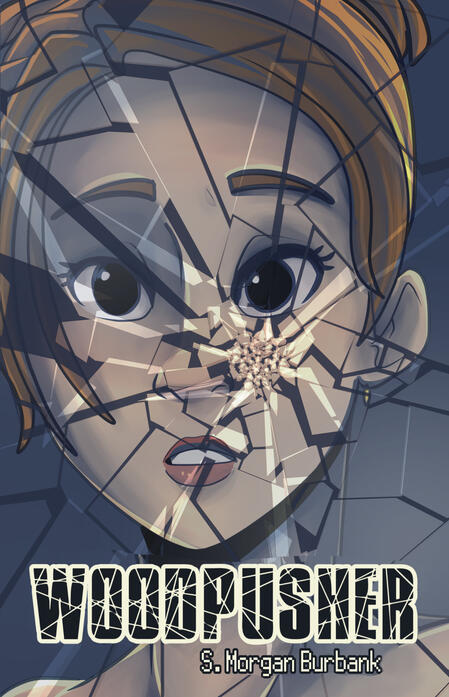
Here on the inaugural article for the Writing Wins series, I’m talking about how a protagonist having flaws is a good thing, even if those flaws are unpleasant or even something you might consider unforgivable. The book for this is: Woodpusher by S. Morgan Burbank. I recommend buying and reading the book before reading this. Maybe even buying the first book in the series, Kotov Syndrome. There will be spoilers after the break, and they’ll be unmarked, so if you care about such things, save this now and go get the book. I’ll still be here when you get back, I promise.
Or click here to find their website.
Still with me? Great. Woodpusher is interesting for this because it’s a sequel, but the protagonist, Erika, has not improved her mental health since the events of Kotov Syndrome, despite her physical well being improving. In some ways, she may have actually gotten worse.
Erika is an alcoholic. There’s no need to put that delicately, because the narrative certainly doesn’t. She’s an alcoholic at the beginning of Kotov Syndrome, and she’s an alcoholic at the end of Woodpusher. Her alcoholism severely hinders her in Woodpusher. I feel like this is significant because Woodpusher is so massively different from its predecessor. Kotov Syndrome is a story that lives in the mundane. Yes, it’s set in the future where AI androids are commonplace, but that’s just set dressing. The story itself is about regular people, with regular problems in something akin to our real world. The alcoholism was a big deal there because it was one of many mundane problems that Erika was dealing with. Mental health, relationships, shitty jobs, and a political moment that feels a lot like our own were central to the book. Meanwhile, in Woodpusher, Erika and Abby have been transported to another universe in order to save the world. Mundane issues can easily take a backseat in a situation like that.
When it comes to Erika, at least, her mental health issues do not take a backseat to the world-ending situation. From scene one, it’s clear that Erika is not having a good time, and not because she’s been tasked with saving the world. Within a few paragraphs, we see that Grace, her named inner-critic, is back, and maybe even worse than before. She tells Erika that they’re in Purgatory because, “You managed to be just good enough not to go to Hell immediately, but not good enough you’ll avoid it forever.” Before we even see any of the fantastical elements of the the Azaes Realm, Grace is there, reminding everybody that you can’t escape yourself, no matter where you go.
This continues through the entire book, moving from “nuisance” to “hindrance” before culminating in a full-blown showstopper. All around her, there is intrigue and suspense. Questions about the unseen antagonist. Questions about the protagonists’ plan. Worries about Erika’s lack of combat skills. A brewing feud between two of the major “gods” of the Azaes Realm. And in the middle of all that, Erika and Grace dance, spiraling further and further down, becoming less capable of even the basics of being a person, much less the combat training the rest of the crew require of her. Her alcoholism is completely unmanaged and she’s been forced to quit cold turkey as there is no alcohol in all of the Azaes Realm. This all comes together near the end when Erika and Abbey are sent back to Earth as part of a mission. Erika is sent with money as part of a plan to get her a small amount of liquor in the Azaes Realm in hopes that it would help her manage Grace better and actually be useful. She immediately drank nearly a third of the liquor she bought, before she mission was even properly underway. Reading that scene was so difficult, not because it wasn’t well written, but because, as a reader, we know she’s fucking up in a big way, but it also felt inevitable.
A protagonist shouldn’t be perfect. They should have flaws, even mundane ones, that hinder them. If you can write them in such a way that some plot problems feel like an extension of the protagonist as a person, that’s the goal, I think. Maybe Erika will grow as a person in the next one.

 Modern Authors